A single step income statement is one of the easiest financial statements to understand. It shows whether a business made a profit or a loss during a period.
Many small businesses use this format because it is simple and quick. It does not break income and expenses into many layers.
That is also why people search for it. They want a clear answer, a simple format, and an easy way to prepare it without getting lost in accounting terms.
In this blog, you will learn what a single step income statement is, how it works, what to include, how to prepare it, and when it is the right format for a business.
What is a Single Step Income Statement
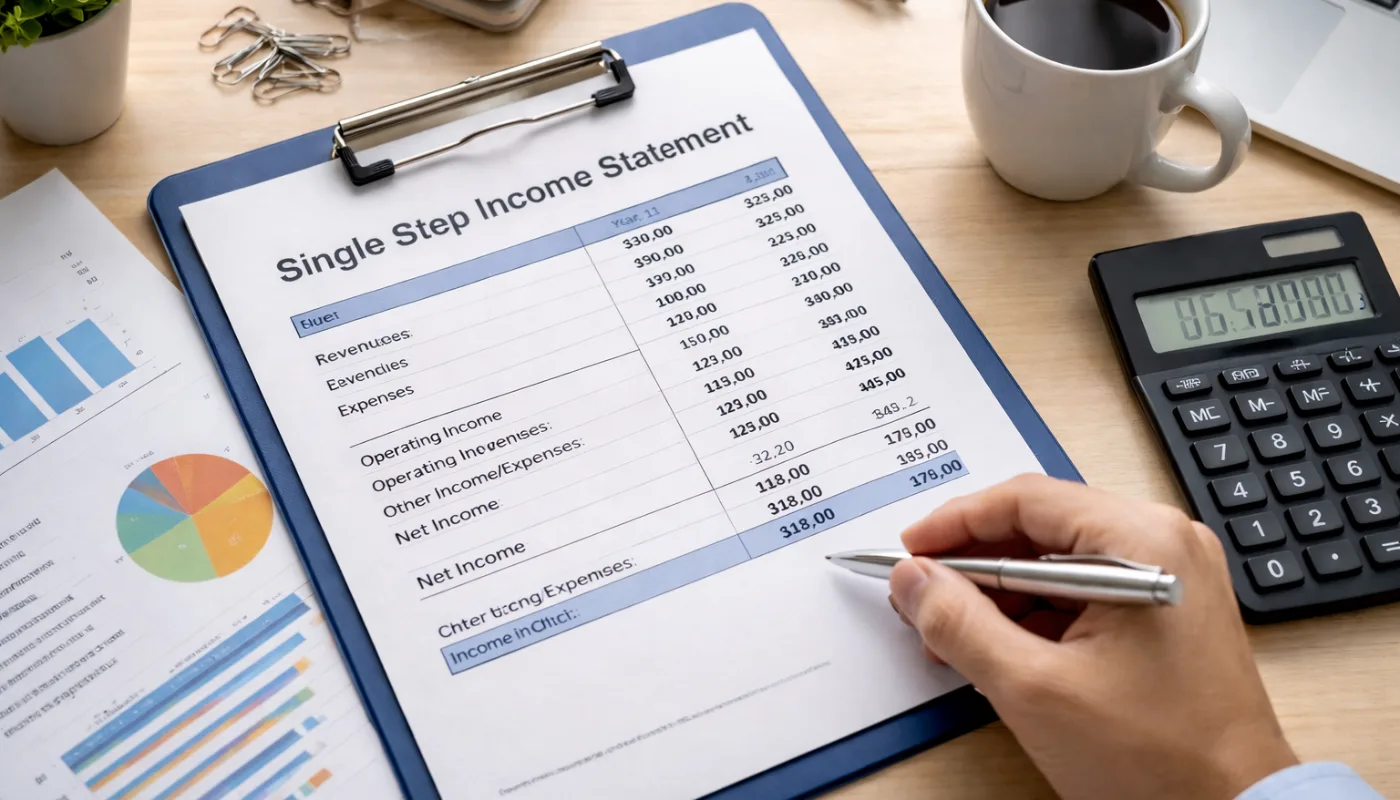
A single step income statement is a simple financial report. It calculates net income in one basic step.
The business adds all revenues and gains together. Then it subtracts all expenses and losses.
So, instead of showing many profit levels, it moves straight to the final number. That final number is net income or net loss.
Why is It Called Single Step Income Statement
It is called a single step income statement because the main calculation happens in one step. You add total income, total expenses, and subtract one from the other.
This format does not usually show gross profit. It also does not usually show operating income.
That makes it easier to prepare. However, it also gives less detail than a multi-step income statement.
Single Step Income Statement Formula
The basic formula is simple:
Net Income = (Total Revenues + Gains) - (Total Expenses + Losses)
This means every income item goes into one section. Every cost item goes into another section.
After that, the business subtracts total expenses from total revenue. The result is the profit or loss for the period.
Main Components of a Single Step Income Statement
A single step income statement has three main parts. These parts are easy to follow.
Component | What It Includes | Why It Matters |
Total Revenues + Gains | Sales revenue, service revenue, interest income, gains on asset sales | Shows all money earned |
Total Expenses + Losses | Cost of Goods Sold (COGS), rent, wages, utilities, taxes, advertising, interest expense | Shows all money spent |
Net Income | Total revenues minus total expenses | Shows final profit or loss |
The strength of this format is clarity. Everything is grouped in a simple way.
The weakness is that it does not separate core business activity from other items. So, analysis becomes more limited.
What Goes Under Revenue?
Revenue is the money a business earns. In a single step income statement, all revenue is grouped together.
This may include:
Sales revenue
Service revenue
Interest income
Rental income
Gains from selling assets
The statement does not usually split these into operating and non-operating sections. That is one reason it looks clean and short.
What Goes Under Expenses?
Expenses are the costs of running the business. These are also grouped together in one section.
Common expense items include:
Salary or wage expense
Rent expense
Utilities expense
Advertising expense
Office expense
Interest expense
Income tax expense
This grouped format makes the statement easy to read. Still, it hides some useful detail about where profit is really coming from.
How to Prepare a Single Step Income Statement
Preparing a single step income statement is not difficult. You just need to organize the numbers in the right order.
1. Select the Reporting Period
Begin by choosing the time period for the statement. It can be prepared for a month, a quarter, or a full year.
2. Combine All Revenues and Gains
List all the income earned during that period and combine them to get total revenues and gains.
3. Add All Expenses and Losses
Next, record every cost and loss and combine them together and find total expenses and losses.
4. Calculate Net Income
Finally, it’s time to subtract total expenses and losses from total revenues and gains. If the result is positive, the business has net income. Or if the amount is negative, it has a net loss.
How to Read a Single Step Income Statement
Reading a single step income statement is simple. But to understand it properly, you should look at each part in order.
Focus on these points:
Total revenues and gains: Shows the full amount the business earned during the period.
Total expenses and losses: Shows the full amount the business spent or lost during the same period.
Difference between the two totals: Helps you see whether the business kept more money than it spent.
Net income: The final result after total expenses and losses are subtracted from total revenues and gains.
Do not look at net income alone. A business may still show profit even when expenses are rising too fast.
It also helps to compare the statement with earlier periods. This makes it easier to notice changes in income, spending, and overall performance.
Who Uses a Single Step Income Statement
This format is common among small businesses. It is also useful for sole proprietors, freelancers, and simple service businesses.
It works well when operations are straightforward. It is also useful when a business wants quick reporting without deep analysis.
In many cases, it is enough for internal use. But larger companies often need more detail.
When is a Single Step Income Statement a Good Choice
A single step income statement is a good fit when the business wants speed and simplicity. It works best when there are fewer line items and fewer reporting needs.
It is often suitable when:
The business is small
The owner wants a simple report
Operations are not complex
Quick profit tracking is enough
Detailed margin analysis is not necessary
If the business needs more insight into operations, another format may be better. That is where the multi-step income statement becomes useful.
Advantages of a Single Step Income Statement
The strongest point of a single step income statement is how straightforward it is. It gives a clear profit or loss figure without adding too many layers.
That makes it useful for businesses that want a simple report. It is also helpful for people who do not work deeply with accounting.
Some of its main benefits are:
The format is simple. And it usually takes less time to make it.
The numbers are presented in a direct way. This makes the statement easier to understand.
A business can prepare and review it without going through many extra steps.
Income is grouped together, and expenses are grouped together, so the report looks clean.
It works well when the main goal is to see whether the business earned or lost money.
Another reason some businesses prefer this format is that it moves quickly to the final result. So, it helps owners or managers check the bottom line without reading a long and detailed statement.
Limitations of a Single Step Income Statement
The biggest limitation is lack of detail. It does not show how profit was earned from normal operations.
For example, it does not usually show gross profit. It also does not usually show operating income.
That makes it harder to measure operating efficiency. It can also make the statement less useful for lenders, investors, or detailed financial analysis.
Here are the main disadvantages:
No gross profit subtotal
No operating income subtotal
No clear separation of operating and non-operating items
Less useful for deeper analysis
Not ideal for complex businesses
So, the format is simple, but simplicity comes with trade-offs. It tells you the result, but not the full story behind it.
Single Step vs Multi Step Income Statement
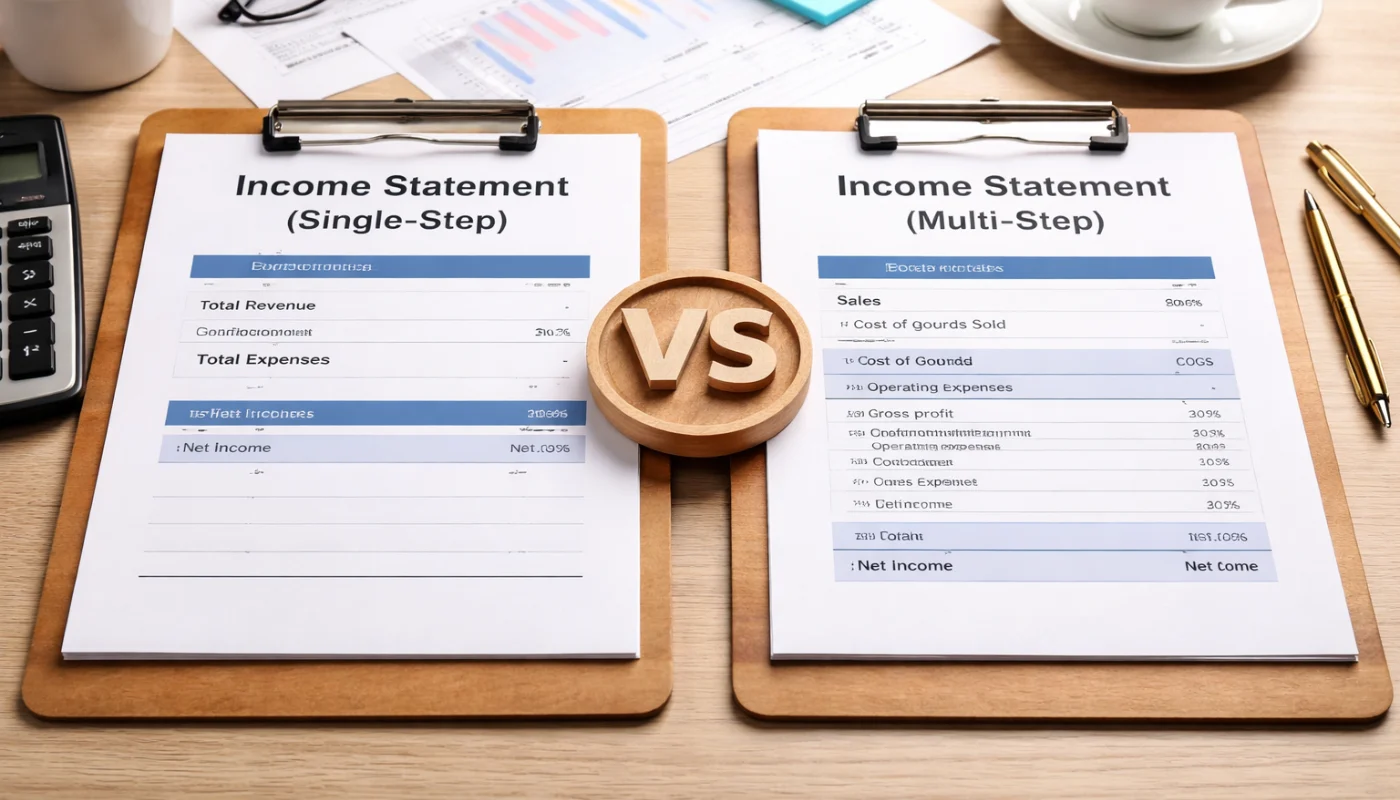
The main difference is detail. A single step income statement gives you net income in one simple calculation.
A multi-step income statement breaks the process into stages. It usually shows gross profit, operating income, and non-operating items separately.
That means both formats can lead to the same final net income. But the multi-step format explains that number in more detail.
If you want full comparison, you can visit the guide single step vs multi-step income statement.
Common Single Step Income Statement Mistakes
Some businesses make the format look simple but still place items in the wrong section. That creates confusion later.
Try to avoid these mistakes:
Forgetting smaller income items like interest income
Leaving out expenses such as utilities or taxes
Mixing different reporting periods
Using estimates without checking records
Assuming the format is best for every business
A simple statement still needs accurate numbers. Clean formatting does not fix poor data.
Bottom Line
A single step income statement gives a quick view of whether a business made a profit or a loss. It puts all income in one section, all expenses in another, and then shows the final net income figure.
This format is a good option when a business needs something clear and easy to follow. It is often useful for small businesses, sole traders, and service-based businesses with simple financial activity.
However, it may not suit every business need. When more detailed analysis, clearer profit breakdowns, or stronger reporting for lenders and investors is needed, a more detailed income statement format may work better.
Frequently Asked Questions
What is the formula for a single step income statement?
The formula is: Net Income = (Total Revenues + Gains) - (Total Expenses + Losses). This is the core calculation used in the format.
What is the main purpose of a single step income statement?
Its main purpose is to show whether a business made a profit or a loss during a period. It gives a quick snapshot of overall profitability.
What are the main parts of a single step income statement?
The main parts are total revenues and gains, total expenses and losses, and net income. These three parts form the full statement.
Who usually uses a single step income statement?
Small businesses often use it. Sole proprietors, freelancers, and service-based businesses also use it because it is easy to prepare.
Does a single step income statement show gross profit?
No, it usually does not. That is one of the biggest differences between a single step income statement and a multi-step income statement.
Is a single step income statement easier than a multi-step income statement?
Yes, it is easier. It has fewer calculations and less classification, so it is faster to prepare and easier to read.