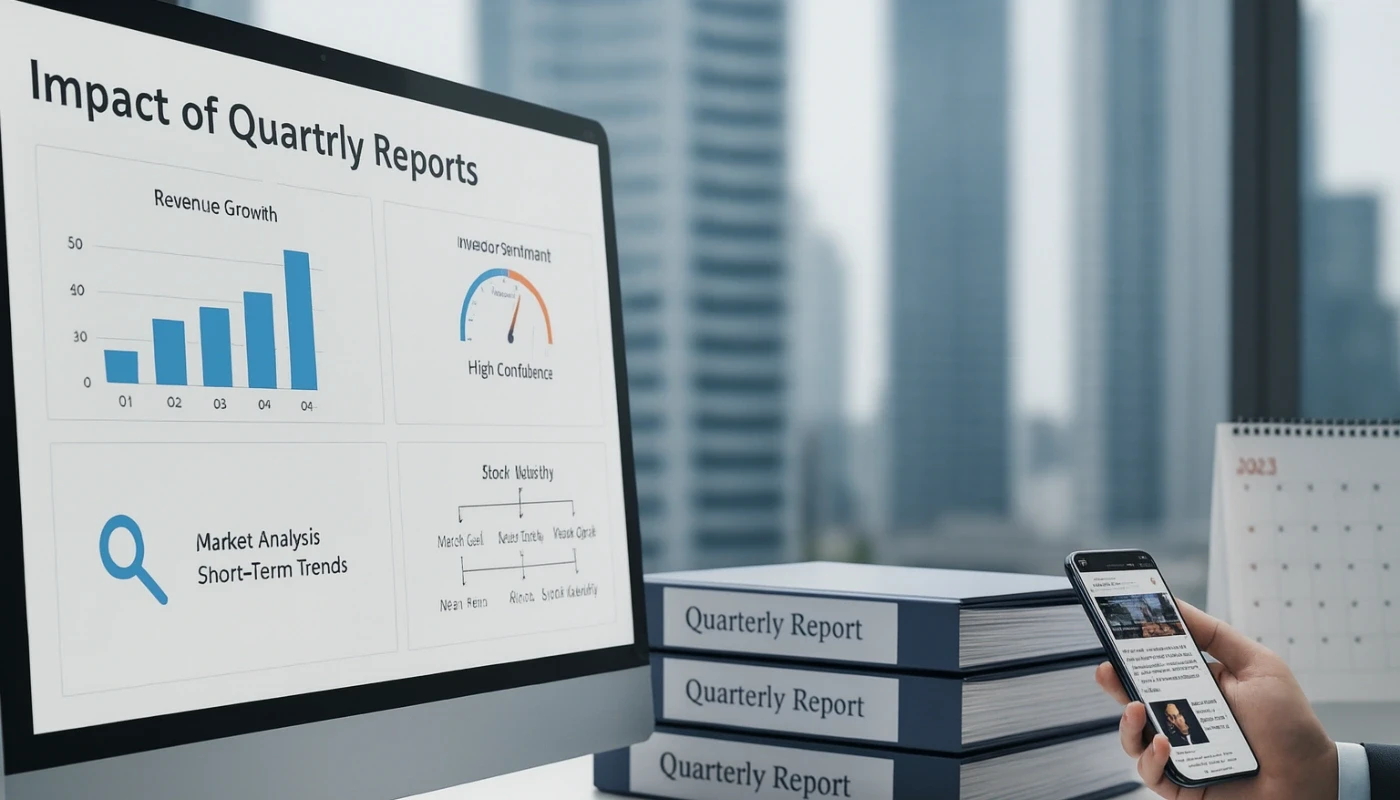
Quarterly reports land every three months and trigger immediate reactions. Stock prices jump or drop within minutes. Executives adjust spending plans. Investors rebalance portfolios.
These reports matter because they create decision points. Companies show whether they met targets. Investors decide whether to hold, buy, or sell. The cycle repeats four times a year, and each cycle pushes both sides toward short term thinking.
This post explains why quarterly reports drive short term decisions, what that means for companies and investors, and how you can use these reports without getting trapped in quarterly noise.
The Role of Quarterly Reports in Timing Decisions
Public companies in the U.S. must file Form 10-Q within 40 to 45 days after each quarter end. This filing includes financial statements, management discussion, and updates on risks.
The report gives you fresh data on revenue, earnings, cash flow, and guidance. Management often hosts an earnings call the same day to explain results and answer analyst questions.
This timing creates urgency. You have new information. Competitors have it too. Waiting means others act first.
Key Reasons for the Short Term Focus
Market Expectations: Analysts publish earnings estimates before each quarter. These estimates become the benchmark. Beat the estimate and the stock often rises. Miss it and the stock often falls, even if the business is healthy.
The market prices in expectations. Meeting them is not enough. You must exceed them or explain why you did not.
Investor Decision Making: Institutional investors face performance pressure. Fund managers get evaluated quarterly. Underperformance for two or three quarters can cost them clients or their job.
This pressure flows to portfolio decisions. If a holding misses earnings twice in a row, many managers sell rather than wait for a turnaround. They cannot afford to look wrong quarter after quarter.
Retail investors react too. Apps like Robinhood and Webull send earnings alerts. Social media amplifies reactions. A revenue miss becomes a trending topic within hours.
Management Incentives: Executive compensation often ties to quarterly or annual performance. Stock options, restricted stock units, and annual bonuses vest based on hitting targets.
Examples include cutting R&D spending, delaying product launches, or pulling forward revenue through aggressive discounting.
Transparency and Accountability: Quarterly reporting creates discipline. Management cannot hide problems for a year. Investors get four checkpoints to assess progress.
This transparency benefits markets. Information flows faster. Mismanagement gets exposed sooner. Investors can adjust positions before small problems become catastrophic.
But transparency also amplifies short term volatility. Every quarterly stumble becomes public immediately.
Competitive Pressure: When your competitors report strong quarters, you face pressure to match them. If Competitor A grows revenue 15% and you grow 8%, investors question your strategy even if your 8% is sustainable and their 15% is not.
This pressure pushes companies to chase growth rates and margins that might not be realistic or healthy for their business model.
The Ongoing Debate: Pros and Cons
The impact of quarterly reporting has long been debated. Supporters argue it creates transparency and accountability. Critics say it forces companies to sacrifice long term strategy for short term results. Here is what each side argues.
Argument For | Argument Against |
Transparency: Provides investors with regular, reliable information to make informed decisions. Four updates per year reduce information asymmetry between management and shareholders. | "Short-Termism": Encourages companies to sacrifice long term growth (e.g., R&D, capital investment) for short term profits. Projects get delayed to avoid quarterly earnings hits. |
Market Efficiency: Helps the market reflect actual company values more accurately and lowers the cost of capital. Prices adjust quickly to new information, keeping stocks closer to fair value. | Burdensome: Imposes substantial time, expense, and compliance costs on management, particularly for smaller firms. Preparing four reports annually consumes significant resources. |
Accountability: Holds management accountable to shareholders and provides a forum for analysts to ask questions. Executives cannot delay bad news for 12 months. | Manipulation: Leads to practices like "managing earnings" to meet analyst expectations, rather than focusing on the true economics of the business. Encourages accounting tricks and aggressive revenue recognition. |
Early Detection: Problems show up in Q1 rather than waiting until year end. Declining margins or weakening cash flow become visible sooner, allowing investors to act faster. | Excess Volatility: Stock prices swing dramatically on small misses or beats that do not reflect real business changes. A 2% revenue miss might trigger a 15% stock drop. |
Why This Debate Matters for Short Term Decisions:
Quarterly reporting gives you frequent visibility into performance, yet it pushes companies and investors toward short term actions. The structure rewards quick results and quick reactions. If you choose firms that stay focused on long term plans, you face more volatility but you raise your chances of better outcomes over time.
Why Short Term Decisions Follow Quarterly Results
Quarterly results create four decision points each year. Each point resets expectations.
Guidance changes. Management updates full year guidance after each quarter. If they lower guidance in Q2, investors recalibrate expectations for Q3 and Q4. Some sell immediately rather than wait.
Relative performance. Investors compare your quarterly results to competitors who reported the same week. Underperformance triggers sell decisions even if your results are acceptable in isolation.
Momentum shifts. Three strong quarters build momentum. One weak quarter breaks it. Momentum investors pile in during winning streaks and exit fast when the streak ends.
Analyst rating changes. Analysts downgrade stocks after disappointing quarters and upgrade after strong ones. These rating changes move prices and influence other investors.
Each quarterly cycle reinforces short term thinking because the next report is only 90 days away.
What This Means for Companies
Companies face a trade off. Do you optimize for this quarter or for the next three years?
Spending shifts. Some companies cut discretionary spending in the last month of a quarter to hit earnings targets. Marketing budgets get frozen. Hiring slows. Projects get delayed.
Project timing. A company might delay launching a new product from Q4 to Q1 of the next year to avoid the upfront costs hitting this year's results.
Guidance games. Some management teams set low guidance they know they can beat. This creates predictable "beats" each quarter, which keeps the stock stable but sacrifices credibility.
What to Look For
You want companies that maintain investment and strategy despite quarterly pressure. Watch for:
Consistent R&D spending as a percentage of revenue
Long term projects that continue even when they hurt near term margins
Management commentary that focuses on multi year goals, not just next quarter
Willingness to miss a quarterly estimate if it serves the long term plan
Companies like Amazon famously prioritized long term growth over quarterly profits for years. Jeff Bezos told shareholders in his 1997 letter that Amazon would focus on long term market leadership, not short term profit or Wall Street reactions.
What This Means for Investors
Reacting to each quarter without context increases your risk and transaction costs.
Volatility risk. If you sell every time a company misses and buy every time it beats, you whipsaw yourself. Transaction costs and taxes eat returns.
Missing recoveries. Many stocks that miss one quarter recover within two or three quarters. Selling after Q1 disappointment means you miss the Q2 rebound.
Overreaction. Markets often overreact to quarterly results. A 10% stock drop on a 3% revenue miss might create a buying opportunity if the business fundamentals remain intact.
What You Should Do
Compare each quarter to the same quarter last year, not just the prior quarter. This removes seasonality.
Read the full 10-Q, not just the press release. Press releases highlight positive metrics. The 10-Q includes everything, including problems buried in footnotes or MD&A.
Listen to the earnings call. Management tone and analyst questions reveal concerns the numbers might not show.
Track trends over multiple quarters. One weak quarter is noise. Three weak quarters is a trend.
How to Use Quarterly Reports Effectively
Here is a practical approach:
Your Quarterly Review Checklist
Revenue performance:
Did revenue beat, meet, or miss estimates?
How does this quarter compare to the same quarter last year?
Which segments or geographies drove the change?
Margin trends:
Did gross, operating, and net margins expand or contract?
What did management say caused the change?
Cash flow:
Did operating cash flow grow or shrink?
How does free cash flow compare to net income?
Balance sheet:
Did debt increase or decrease?
Are receivables or inventory growing faster than revenue?
Guidance:
Did management raise, lower, or maintain full year guidance?
How confident do they sound about the guidance?
Compare Quarter-on-Quarter and Year-on-Year
Metric | Q3 2024 | Q2 2024 | Q3 2023 | QoQ Change | YoY Change |
Revenue |
|
|
|
|
|
Operating Margin |
|
|
|
|
|
Free Cash Flow |
|
|
|
|
|
Sequential comparison (Q3 vs. Q2) shows momentum. Year over year comparison (Q3 2024 vs. Q3 2023) removes seasonality and shows real growth.
Combine Numbers with Management Commentary
Numbers tell you what happened. MD&A tells you why and what comes next.
If revenue fell 5%, did it fall because of one lost customer, a product delay, or industry wide weakness? The number is the same but the implications differ completely.
If management says "we expect headwinds to continue for two more quarters," you know the problem is not fixed yet.
Balance Short Term Signals with the Long Term Story
Ask yourself: does this quarterly result change my long term thesis?
If you bought the stock because the company dominates a growing market and has strong competitive advantages, one weak quarter probably does not invalidate that thesis.
If you bought because of momentum and the momentum just broke, the thesis might be dead.
Separate signal from noise. Quarterly results are noisy. Long term performance is the signal.
Bottom Line
Quarterly reports create urgency. They force companies and investors to make decisions every 90 days.
This cycle drives short term behavior. Companies adjust spending to hit targets. Investors react to beats and misses. Both sides optimize for the next quarter, sometimes at the expense of the next three years.
You cannot ignore quarterly reports because markets price them in immediately. But you also cannot let them dominate your decisions. Use them as checkpoints to track progress against your long term thesis. Watch for trends across multiple quarters. Focus on metrics that predict future performance, not just past results.
The best investors and the best companies treat quarterly reports as important but not decisive. They use the discipline of quarterly reporting without getting trapped by quarterly thinking.
Frequently Asked Questions
Why do stocks drop even when companies beat earnings estimates?
Beating estimates is not enough if guidance disappoints or the beat is small. Markets price in expectations before the report, so the stock already reflects a likely beat. Only a significant beat or raised guidance drives the stock higher.
Should I sell immediately after a company misses earnings?
Not automatically. Read why they missed and whether the problem is temporary or structural. One miss might be noise. Three misses suggest a real problem worth exiting.
How do I know if a quarterly miss is temporary?
Look at management's explanation and compare to peers. If the whole industry had a weak quarter due to supply chain issues or weather, the problem is likely temporary. If only this company missed, the problem might be company specific.
Do all companies report quarterly?
All U.S. public companies must file quarterly reports. Some other countries only require semiannual reporting. Private companies do not have to report publicly at all.
What is the biggest mistake investors make with quarterly reports?
Overreacting to single quarters and ignoring trends. One weak quarter does not break a company. Three weak quarters might. Focus on direction, not individual data points.
How long does it take for a stock to recover after missing earnings?
It varies widely. Some recover in days if the miss was small. Others take quarters if the miss signals deeper problems. Recovery speed depends on whether the market believes the problem is fixable.
Should I read the full 10-Q or just the earnings release?
Read the full 10-Q if you own the stock or plan to invest. The press release highlights good news and glosses over problems. The 10-Q includes everything and often reveals risks the press release omits.
What quarterly metrics matter most for long term investors?
Revenue growth consistency, free cash flow trends, and whether management is investing in growth despite quarterly pressure. These predict long term value better than quarterly EPS beats.