Every business owns assets and also owes money to others. The difference between what a company owns and what it owes is one of the most important numbers in finance. This number is called shareholder equity.
Shareholder equity shows the real ownership value of a company. It informs investors and business owners how much value is left after settling all debt. Therefore, it plays an important role in a company's balance sheet and is commonly used to assess financial health.
If a company sold everything it owned and settled all its debts, the remaining amount would be for the shareholders. This remaining amount is shareholder equity.
In this blog, we will make clear what shareholder equity is. We will also discuss how to calculate it, the key parts of it, and why it holds importance for investors as well as businesses.
What is Shareholders’ Equity (SE)
Shareholder equity, also known as stockholders’ equity, stands for the net worth of a company that is owned by its shareholders or owners.
It shows the remaining value of a company’s assets after all liabilities are paid.
In simple terms:
Assets = What a company owns
Liabilities = What a company owes
Shareholder Equity = What belongs to the owners
If the company liquidated all assets and paid all debts, the remaining amount would be distributed to shareholders.
For this reason, people often refer to shareholder equity as the book value or net worth of the company.
Key Components of Shareholders’ Equity
Shareholders’ equity is not a single number. It is made up of several accounts shown in the equity section of a company’s balance sheet. These components explain how the company raised money and how profits were used over time.
1. Share Capital (Common and Preferred Stock)
Share capital is the money a company raises by selling shares to investors. It represents the initial investment made by shareholders. It usually includes:
Common stock: The basic ownership shares of a company
Preferred stock: Shares that often receive dividends before common shareholders
This amount shows how much capital investors contributed to the business.
2. Retained Earnings
Retained earnings are the profits that a company holds onto instead of distributing them as dividends to its shareholders.
Companies often use retained earnings to:
Expand operations
Invest in new projects
Pay off debt
Support business growth
Over time, profitable companies usually build large retained earnings balances.
3. Additional Paid-In Capital (APIC)
Additional paid-in capital is the extra amount investors pay above the stock’s par value.
For example:
Par value of share = $1
Investor buys share for $10
The extra $9 becomes additional paid-in capital.
This shows how much extra funding the company received from shareholders.
4. Treasury Stock
Treasury stock refers to shares the company has bought back from investors.
When a company buys back its own shares, these are noted as treasury stock. Since the company uses cash to purchase them again, treasury stock lowers the overall equity of shareholders.
5. Accumulated Other Comprehensive Income (AOCI)
Accumulated Other Comprehensive Income includes specific gains and losses that do not belong to regular profit or loss.
These may come from:
foreign currency translation changes
pension plan adjustments
unrealized gains or losses on certain investments
Although these items are not included in net income, they still affect the total value of shareholders’ equity.
How to Calculate Shareholders’ Equity (Formula and Methods)
There are two common ways to calculate shareholders’ equity using financial statement data.
Formula 1: Basic Accounting Equation
The first method uses the basic accounting equation. It is the simplest and most widely used method to calculate shareholders’ equity.
See the formula below:
Shareholder Equity = Total Assets − Total Liabilities
This means you subtract everything the company owes from everything the company owns.
Assets include items such as cash, inventory, equipment, and property.
Liabilities include debts, loans, accounts payable, and other financial obligations.
When you subtract total liabilities from total assets, what is left over shows the value that is for shareholders.
Formula 2: Investor’s Equation
This method is referred to as the share capital technique, sometimes also known as the investor’s equation. It focuses on the money that has been invested in the company and the profits it has retained over time.
Review the formula below:
Shareholders’ Equity = Share Capital + Retained Earnings − Treasury Stock
Let’s understand each term:
Share capital: The money investors pay to buy shares of the company.
Retained earnings: The profits the company does not pay out as dividends but keeps instead.
Treasury stock: Represents shares the company has bought back from investors.
All of these figures can be found in the shareholders’ equity section of a company’s balance sheet.
Real-World Example of Shareholders’ Equity
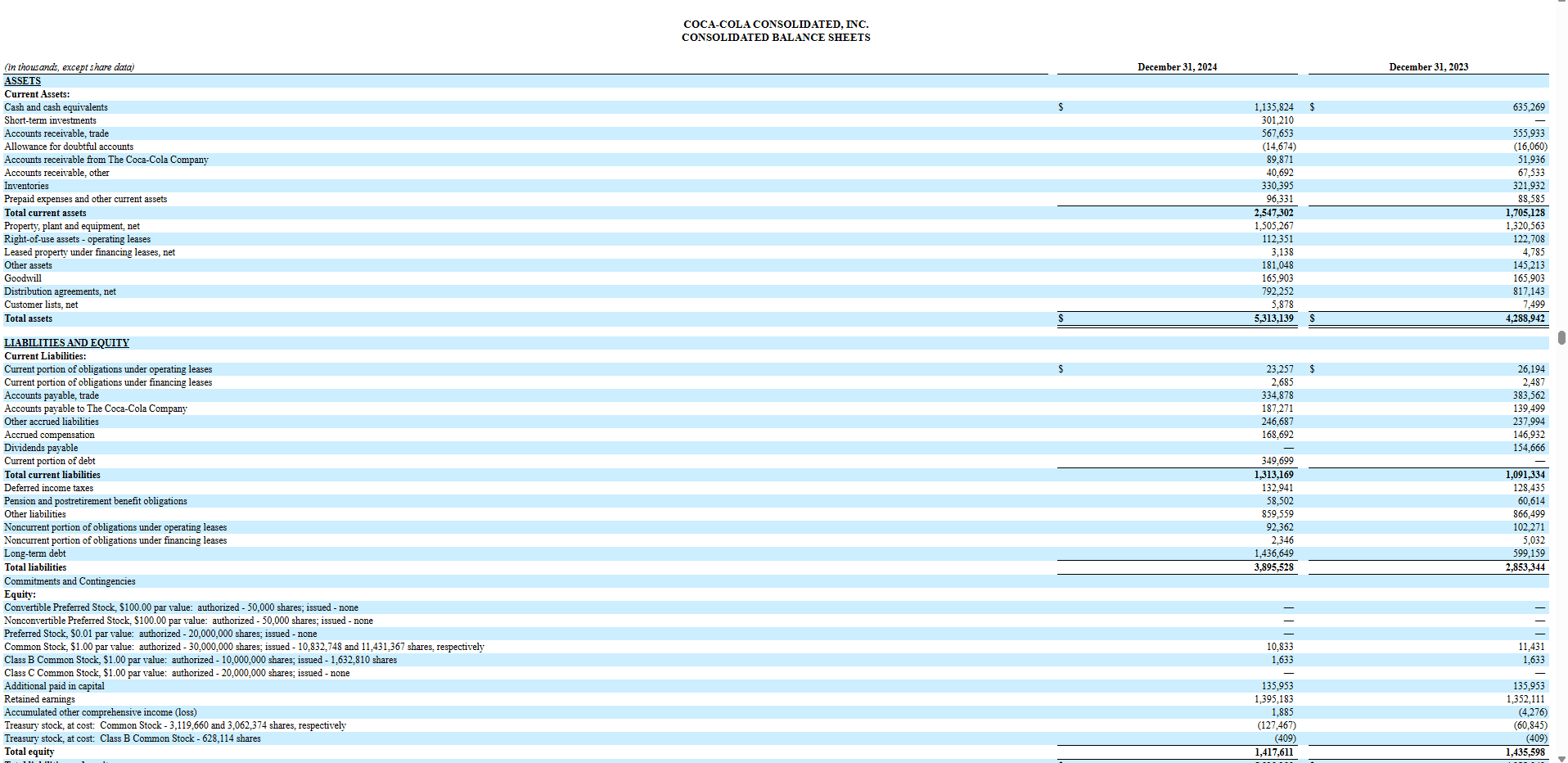
To see how shareholders’ equity appears in an actual financial statement, review the Coca-Cola Company’s balance sheet below.
Positive vs. Negative Shareholders’ Equity
Shareholder equity can be positive or negative.
Aspect | Positive Shareholder Equity | Negative Shareholder Equity |
What it means | The company owns more assets than it owes. | The company owes more than it owns. |
Financial condition | Indicates the business is financially stable and has net value. | May signal financial trouble or weak financial position. |
Shareholder value | Shareholders still have ownership value in the company. | Shareholders may have little or no remaining value. |
Possible reasons | Usually happens due to strong profits, asset growth, or reinvested earnings. | Can happen due to long-term losses, high debt, large dividends, or share buybacks. |
What it indicates | Generally considered a healthy financial sign. | Can be a warning sign of financial risk or possible insolvency. |
Why Shareholders’ Equity Matters
Shareholder equity is widely used by investors, analysts, and business owners. Here are the key reasons why it is important.
To measure financial health: Positive equity means the company owns more assets than liabilities. And this signifies financial stability.
To represent the owners’ stake: Shows the value that belongs to shareholders after all debts are paid.
To indicate business expansion: Over time, if the equity is increasing often, it can mean that the company is making a profit and investing back its earnings.
To help investors analyze companies: Investors use equity to compare companies and evaluate long-term stability.
To be used in key financial ratios: Metrics like Return on Equity (ROE) use shareholder equity to measure how efficiently a company generates profit.
To emphasize solvency risk: Negative equity means liabilities exceed assets. And this might be an alert for financial trouble or possible insolvency.
Shareholders’ Equity Ratio
The shareholders’ equity ratio shows how much of a company’s assets are financed by equity instead of debt.
The formula is:
Shareholders’ Equity Ratio = Shareholders’ Equity ÷ Total Assets
A higher ratio means the company relies more on shareholder funding rather than borrowing.
Shareholders’ Equity vs. Market Value
Many people confuse shareholder equity with a company’s market value. However, they are different.
Basis | Shareholders’ Equity | Market Value |
What it means | The value of the company that belongs to shareholders after all debts are paid. | The total value investors currently place on the company in the stock market. |
Calculation formula | Total Assets − Total Liabilities | Current Share Price × Total Outstanding Shares |
Based on | Accounting records shown in financial statements | Investor demand and stock market trading |
Where it appears | Listed in the equity section of the balance sheet. | Reflected in the company’s market capitalization. |
What it shows | The company’s financial position based on past transactions and accounting records. | Investors’ expectations about the company’s future growth and profitability. |
How often it changes | Usually changes only when new financial statements are released. | Can change daily as the stock price moves. |
Purpose for Investors | Helps understand the company’s book value and financial stability | Shows the current market worth of the company in the eyes of investors |
Where to Find Shareholder Equity in Financial Statements
Shareholder equity is located in the equity section of the balance sheet. It usually appears after liabilities and includes line items such as:
common stock
preferred stock
retained earnings
additional paid-in capital
treasury stock
Companies also publish a Statement of Shareholders’ Equity, which shows how equity changes during an accounting period.
Bottom Line
Truly, shareholder equity is one of the easiest methods to grasp a company's financial power. It shows you the value that genuinely belongs to owners after settling all debts. Investors often look at this number first when reviewing a company’s balance sheet.
Shareholders' equity alone cannot determine the full value of a company, but it provides a good understanding of financial stability, ownership worth and long-term business health.
If you regularly analyze balance sheets or review company finances, Global Filings can make this process much easier. Its AI-powered Corporate Filings helps you quickly access shareholders’ equity data and understand ownership value without digging through lengthy reports. You can start a free trial to simplify your financial analysis.
Frequently Asked Questions
What is shareholders’ equity on a balance sheet?
Shareholders’ equity is the part in a balance sheet which displays owners' rights on company assets after you subtract liabilities. It consists of items like share capital, retained earnings, and treasury stock.
Is shareholders’ equity an asset?
No. Shareholders’ equity is not considered an asset. It symbolizes the owners' stake in the company after all debts are deducted from overall assets.
Is shareholder equity the same as net worth?
Yes. Often, people think of shareholder equity as the net worth or book value of a company.
Where can I find shareholder equity in financial statements?
To find shareholders’ equity in financial statements, you should look at the balance sheet's equity section. Normally, it is noted following liabilities and contains things such as share capital and retained earnings.
What increases shareholder equity?
When a company makes profit and retains it within business, shareholder equity goes up. It can further rise if the company introduces new shares and collects capital from investors.
What decreases shareholder equity?
When a company reports losses or pays dividends to shareholders, the equity of shareholders goes down. It may also decrease if the company purchases its own shares back (share buybacks).